日本語版: タイの年金はタイに住んでいなくても受け取れる?
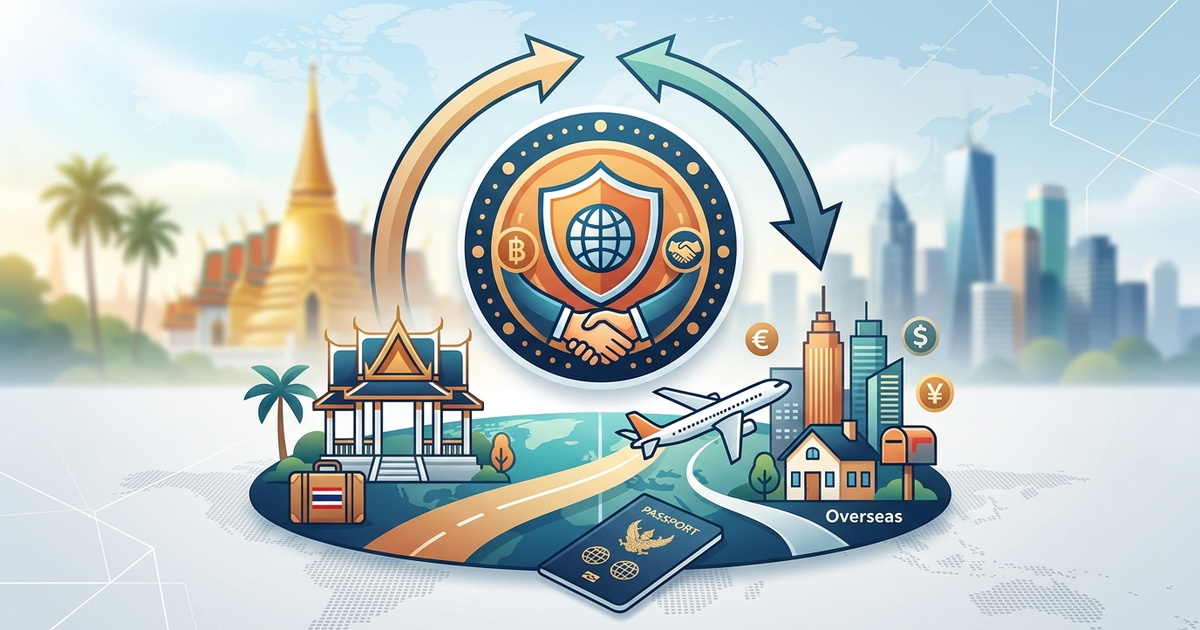
This is the question I hear most often. The short answer is: yes, you can — and you don’t need to travel back to Thailand to do it. The benefit you earned by paying into Thai social security stays with you for the rest of your life, no matter where you settle.
There are, however, a few moving parts depending on whether your benefit is a one-time lump sum or a monthly lifetime pension. Let’s walk through each.
- Two forms of benefit, two slightly different paths
- Where the benefit can be paid
- Yes, paperwork goes back and forth with Thailand
- The Royal Thai Embassy step (for benefits paid outside Thailand)
- Timeline summary
- What about the annual proof of life — can I do it from home?
- Frequently asked questions
- Read next
- How I can help you with the application
- Service fee
- About the author
- Get in touch
Two forms of benefit, two slightly different paths
The Thai SSO old-age benefit comes in two forms, and which one applies to you is determined automatically by how long you contributed:
- Lump sum — for contribution periods under 180 months (15 years). You receive one payment in full.
- Lifetime pension — for contribution periods of 180 months or more. You receive a monthly amount for life.
If you contributed for even one month while you worked in Thailand, you have a claim — provided you are 55 or older and no longer enrolled in Thai social security. For most former expat workers, who typically worked in Thailand for between one and ten years, the benefit will be a lump sum.
Where the benefit can be paid
Here is the practical difference that matters most when you no longer live in Thailand:
| Benefit form | Where it can be paid |
|---|---|
| Lump sum | A bank account in any country — your country of residence, Thailand, or anywhere else |
| Lifetime pension | A Thai bank account only, in practice |
For lump sums, your country of residence is irrelevant. Wherever you live now, the SSO will transfer the lump sum to your local bank account. If you happen to still have a Thai bank account, you can use that instead and get the money a bit sooner.
For lifetime pensions, the practical reality is that recipients use a Thai bank account and, if needed, withdraw the funds to their home country using a money-transfer service. While the SSO does not formally publish a rule that says “Thai account only,” in every case I have seen the actual transfer was made to a Thai account. If you have closed your Thai account and are entitled to a lifetime pension, the simplest practical step is to open a new Thai account on your next visit — even a short trip is enough.
Yes, paperwork goes back and forth with Thailand
Regardless of where you live, the SSO needs documentary proof of your identity and your eligibility, and that means physical documents need to travel between you and Thailand. The good news is that everything can be done by post — you do not need to fly to Thailand for any part of the process.
For a lump sum application, the paperwork happens once, up front. You sign the application form, the bank-book copy, and the passport copy, mail them to Thailand, and the SSO files the claim. The money arrives in 1–6 months depending on the receiving account (see below).
For a lifetime pension, there is an additional annual step: the proof-of-life certificate, due each October. This is the SSO’s way of confirming that you are still alive and entitled to continued payments. If you live outside Thailand, you obtain the certificate at a Royal Thai Embassy or Consulate in your country of residence. Without this annual step, payments are suspended.
The Royal Thai Embassy step (for benefits paid outside Thailand)
When the receiving account is in your home country rather than in Thailand, the SSO routes the verification through the Royal Thai Embassy in that country. The flow is:
- You file the application in Thailand (with my help, by mailing the documents)
- The SSO sends a verification letter to its embassy in your country
- The embassy forwards the letter to you by post
- You sign and return it
- The SSO releases the payment to your home-country account
This extra round trip is why payment takes 3–6 months for home-country accounts, versus 1–2 months for Thai accounts. The verification step is not optional — it is how the SSO confirms that the right person is receiving the money.
The required documents at the embassy step vary by country. In most cases, your current valid passport is sufficient. If your passport has expired between filing and the embassy step (a process that can take months), an alternative government-issued photo ID is usually accepted — see Applying with an expired passport for details.
Timeline summary
| Benefit form | Receiving account | Time from filing to payment |
|---|---|---|
| Lump sum | Thai bank account | 1–2 months |
| Lump sum | Bank account outside Thailand | 3–6 months |
| Lifetime pension | Thai bank account (in practice) | Payments start within a few months of approval; annual proof of life thereafter |
What about the annual proof of life — can I do it from home?
Yes. If you receive a lifetime pension and live outside Thailand, the annual October proof of life is issued at a Royal Thai Embassy or Consulate in your country. Many countries have more than one Thai consular office, so you typically don’t have to travel to the capital — check the official pages of the offices nearest you. The exact requirements (notarized passport copy, application form, in-person appearance) vary slightly by office.
The certificate is then forwarded to the SSO in Thailand. I can help with this Thailand-side step if you would like — see How I can help.
Frequently asked questions
Q. Do I need a Thai address or phone number to apply?
No. Your current home-country address and phone number are what go on the form. There are some application variants that require a Thailand-side contact for the SSO to mail confirmations to; in those cases I can act as the contact for you, which is one of the reasons most overseas applicants ask me to file on their behalf.
Q. What if I don’t have any Thai bank account at all?
That’s fine. For a lump sum, your home-country account works directly. For a lifetime pension, opening a Thai account on a future visit is the cleanest solution, but this is not an urgent step — lifetime pension payments are not lost while you arrange an account.
Q. Does the SSO transfer in Thai baht or my local currency?
For home-country accounts, the transfer is converted to the local currency before it reaches your bank, typically at the exchange rate on the day of transfer. The exact mechanism (which intermediary bank does the conversion, whether there are wire fees deducted) varies by country and by your bank. Expect the deposited amount to be slightly below the calculated THB amount × spot rate.
Q. Is it really safe to mail original documents to Thailand?
You don’t mail originals. You mail signed photocopies of your passport and bank book, plus the original signed application form. Nothing irreplaceable goes in the package.
Q. Should I use a different service if I want my money in USD or EUR?
No. The SSO transfer mechanism is the same regardless of currency. The only thing that changes is which Royal Thai Embassy handles the verification step.
Read next
- The complete guide to Thailand’s old-age benefit
- How much can I actually receive?
- DIY or hire help — which is right for me?
- I don’t remember my SSO number — what can I do?
How I can help you with the application
If you live outside Thailand and don’t want to navigate the embassy step and Thai-side paperwork yourself, I take care of the entire application for you. I tell you exactly which documents to prepare, you mail them to me in Thailand by international registered mail, and I file the application at the SSO on your behalf. I also follow up with the Royal Thai Embassy step as needed.
Service fee
The fee depends on the bank account you want to receive the benefit into:
| Receiving account | Fee | Payment method |
|---|---|---|
| Thai bank account | THB 7,000 | Bank transfer (SCB) |
| Japanese bank account | JPY 35,000 | Bank transfer (SBI Sumishin Net Bank) |
| Bank account in any other country | USD 198 | Secure card payment via Stripe |
This is a flat fee. There is no success fee and no additional charges, regardless of how much you receive. If it turns out that you are not eligible, I refund the full amount.
About the author
I’m Takehiko Nishizawa, originally from Saitama, Japan. I have been working for a Japanese company in Thailand for 25 years. During that time I have helped more than 40 former expat workers claim their social security old-age benefit from the Thai SSO. Every applicant who knew their Social Security number has successfully received their benefit. There have been no failed cases.
Get in touch
For questions or to start your application, please contact me through this form. I usually reply within 24 hours. You can also find me on X at @nisizawa.
This article provides general information about Thailand’s social security old-age benefit and is based on the author’s hands-on experience helping former expat workers file their claims. It does not constitute legal, tax, or financial advice. Tax treatment of the benefit varies by your country of residence — please consult a local tax or legal advisor for your specific situation. Procedures and amounts at the Social Security Office may change without notice; the description here reflects practice as of 2026.


コメント